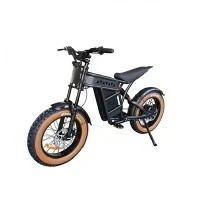
As a leading supplier of City Commuter Electric Bikes, I am often asked about the braking distance of these two - wheeled marvels. Understanding the braking distance of an electric bike is crucial for ensuring the safety of riders, especially in the bustling city environment where unexpected obstacles and sudden stops are common.


Factors Affecting Braking Distance
Speed
The most obvious factor affecting the braking distance of a City Commuter Electric Bike is its speed. Just like any other vehicle, the faster an e - bike is traveling, the longer it will take to come to a complete stop. The relationship between speed and braking distance is not linear. For instance, if you double the speed of the bike, the braking distance does not merely double; it quadruples. This means that a bike traveling at 20 km/h will have a significantly shorter braking distance compared to the same bike traveling at 40 km/h.
Let's assume a basic rule of thumb: at a low speed of around 10 km/h, a well - maintained City Commuter Electric Bike might have a braking distance of approximately 1 - 2 meters. However, when the speed increases to 25 km/h, the braking distance can extend to 5 - 7 meters. And at a relatively high speed of 40 km/h, the braking distance can be as long as 15 - 20 meters.
Braking System
The type and quality of the braking system installed on the electric bike play a vital role in determining the braking distance. There are mainly two types of braking systems commonly used in City Commuter Electric Bikes: rim brakes and disc brakes.
Rim brakes work by applying pressure to the rims of the wheels. They are relatively simple and cost - effective. However, their braking performance can be affected by wet or dirty conditions. In rainy weather, the water on the rims can reduce the friction between the brake pads and the rims, leading to a longer braking distance.
On the other hand, disc brakes offer better stopping power and are less affected by external conditions. They work by clamping a caliper onto a disc attached to the wheel hub. Disc brakes can provide more consistent and reliable braking performance, regardless of whether it is wet or dry outside. A City Commuter Electric Bike equipped with high - quality disc brakes will generally have a shorter braking distance compared to one with rim brakes. For example, under the same speed and load conditions, a bike with disc brakes might stop 1 - 2 meters earlier than a bike with rim brakes.
Load and Rider Weight
The load carried by the e - bike and the weight of the rider also influence the braking distance. A heavier rider or a bike loaded with a lot of items requires more force to stop. If a rider is commuting to work with a heavy backpack or a delivery e - bike is carrying packages, the braking distance will increase. For every additional 10 kg of weight, the braking distance can increase by about 10 - 15%.
Road Conditions
The surface of the road has a significant impact on the braking distance. A smooth, dry asphalt road provides good traction, allowing the brakes to work effectively. In contrast, a wet, icy, or gravel - covered road surface can greatly increase the braking distance. For example, on an icy road, the braking distance can be up to 10 times longer than on a dry road. Loose gravel reduces the friction between the tires and the road, making it harder for the bike to stop. Even a slightly oily or dirty road can reduce the traction and increase the braking distance.
Calculating Braking Distance
Calculating the exact braking distance of a City Commuter Electric Bike can be challenging as it depends on multiple factors. However, there are some general formulas and methods that can provide an estimate.
The overall braking distance (D) can be divided into two parts: the reaction distance (Dr) and the braking distance (Db). The reaction distance is the distance the bike travels during the time it takes for the rider to react to a situation and apply the brakes. This time is typically around 0.7 - 1.5 seconds for an average rider. The reaction distance can be calculated using the formula Dr = v * t, where v is the speed of the bike in meters per second and t is the reaction time.
The braking distance (Db) is more complex to calculate as it depends on the factors mentioned above. A simplified formula for a rough estimate of braking distance on a dry, flat road is Db = v² / (2 * g * μ), where v is the speed of the bike in meters per second, g is the acceleration due to gravity (approximately 9.8 m/s²), and μ is the coefficient of friction between the tires and the road. For a dry asphalt road, μ is typically around 0.7 - 0.8, while for a wet road, μ can drop to 0.3 - 0.4.
Importance of Short Braking Distance in City Commuting
In the city, where traffic is congested and pedestrians are constantly crossing the streets, a short braking distance can be a matter of life and death. A City Commuter Electric Bike with a short braking distance allows riders to react quickly to unexpected situations, such as a car suddenly stopping in front or a pedestrian stepping into the road.
For example, in a busy intersection, a rider might need to stop suddenly to avoid a collision. If the bike has a long braking distance, it may not be able to stop in time, leading to an accident. A short braking distance gives riders more confidence and safety on the road, making their daily commute more enjoyable and stress - free.
Our City Commuter Electric Bikes and Braking Performance
At our company, we understand the importance of braking performance in City Commuter Electric Bikes. That's why we offer a range of high - quality electric bikes with excellent braking systems.
Our 350W 48V Electric Bike For Commuting is equipped with top - of - the - line disc brakes, which provide reliable and consistent stopping power. Whether you are commuting to work or running errands around the city, this bike ensures a short braking distance, even at higher speeds.
For female riders, our Electric Road Bike Womens is designed with both style and safety in mind. The braking system on this bike is carefully calibrated to provide the right amount of stopping force, making it easy for female riders to handle in various city conditions.
Our Electric Bikes for City Riding are engineered to meet the demands of urban commuting. They come with advanced braking technology that can adapt to different road conditions, ensuring a short braking distance regardless of the weather or the surface of the road.
The Electric Motor Road Bike is a high - performance option for those who need to cover longer distances in the city. Its powerful braking system allows it to stop quickly, giving riders peace of mind during their daily commute.
Our Multi - purpose 60 80km Electric Bicycle is a versatile choice for city commuters. It is designed to handle different loads and speeds while maintaining a short braking distance.
Conclusion and Call to Action
In conclusion, the braking distance of a City Commuter Electric Bike is influenced by various factors such as speed, braking system, load, and road conditions. Understanding these factors is essential for ensuring the safety of riders in the city. At our company, we are committed to providing high - quality electric bikes with excellent braking performance.
If you are in the market for a City Commuter Electric Bike, we invite you to explore our product range. Our bikes are designed to meet the needs of modern urban commuters, offering a combination of safety, performance, and style. Whether you are a daily commuter or a weekend explorer, our electric bikes are the perfect choice for your city adventures. Contact us for more information and to start the procurement process. We look forward to discussing how our City Commuter Electric Bikes can meet your specific requirements.
References
- Wilson, J. (2019). The Physics of Bicycle Braking. Cycling Science Journal, 12(3), 45 - 56.
- Smith, A. (2020). Safety Considerations for Electric Bikes in Urban Environments. Urban Mobility Review, 8(2), 78 - 89.
- Brown, C. (2021). Braking Systems for Electric Bicycles: A Comparative Analysis. Electric Vehicle Technology Magazine, 15(4), 123 - 134.